
Introducing AI Hub
AI Hub is Numeo's AI dispatcher: it finds, ranks, drafts, and books loads through one search bar, with every commitment under dispatcher approval.
Product
Introducing AI Hub
The problem AI Hub solves
A dispatcher's day is not hard because any single task is hard. It is hard because the same sequence repeats all day, under time pressure, with incomplete information. Open a load board. Run the same filter. Open the next board, run it again. Copy a load into a spreadsheet to compare it against the last lane you ran. Estimate the deadhead. Decide whether the rate is worth a phone call. Email a broker. Wait. Email the next one. A good load can disappear while you are still checking empty miles on the first.
The market makes that worse. Spot rates have hovered near 2.26 dollars a mile, deadhead routinely eats 15 to 30 percent of the miles a truck turns, and brokers keep roughly 13.5 percent on the loads they move. There are around 27,000 brokers and close to 787,000 carriers competing for the same freight, and more than nine in ten of those carriers run ten trucks or fewer. Small fleets do not have a desk of dispatchers to brute-force the boards. They have one or two people doing the search, the math, and the negotiation at once.
AI Hub exists to collapse that loop. It is Numeo's AI dispatcher: it finds loads across your sources, ranks them against your rules, drafts the broker negotiation, and books what you approve. The dispatcher stays in the chair. The repetition moves to software.

Search in plain English
You start by describing what you want, the way you would tell a teammate. No filter trees, no jumping between five portals. Type the constraints that actually matter for the next truck: origin and destination, equipment, how much deadhead you will tolerate, the rate floor you need to make the lane work, and the pickup window.
A query reads like a sentence. "Chicago, IL to anywhere, reefer only, under 30 mi deadhead, min 2.80/mi." Or "Van loads from Chicago to Dallas today." Or "Flatbed from Houston, min 2.60/mi." AI Hub reads the intent, pulls the structured criteria out of it, and turns that into a live search across every source you have connected. If something is ambiguous, it asks a clarifying question instead of guessing.
AI Hub does not replace your load board subscriptions. It signs in with your existing accounts and consolidates them, so one search hits public boards like DAT and Truckstop and brokerage portals like TQL, C.H. Robinson, Arrive, Echo, RXO, Uber Freight, and others at the same time. You stop tab-switching. You ask once.
How it ranks, and what stays your call
Search is only useful if the results are ordered by something you trust. AI Hub filters and ranks against rules you define, not a generic relevance score. Equipment compatibility, preferred lanes, an RPM floor, a deadhead ceiling, broker quality based on payment history and reliability, and driver fit all feed the ranking. Loads that break a hard rule never surface at all, so the shortlist is already clean before you look at it.
That rule set is the important boundary, and it stays yours. AI Hub does not invent its own idea of a good load. It applies your floors and your preferences, weighs rate against deadhead against broker reliability against driver availability, and puts the best matches on top. Change the rules and the ranking changes with them. The agent is the engine; you keep the steering wheel.
Each load on the shortlist carries a status so you always know what is happening to it, not just that it exists. A load can be recommended and waiting for your eyes, matched but not yet contacted, actively being negotiated, emailed, or flagged as needing your input. That status layer matters as much as the search itself, because a dispatcher needs to know which loads are moving and which are stuck.

The chat view above is where you live day to day: you ask, the agent shortlists, and you watch each candidate change state in real time. As loads move into negotiation, the same information rolls up into status bars so a glance tells you where every active thread stands without opening each one.

Drafting the negotiation
This is the part that usually eats the most time, and it is where AI Hub does the most work. Numeo negotiates with brokers by email, not by autonomous voice calls. For a top-ranked load, AI Hub drafts the outreach: an opening rate aligned with your configured floor, sent to the broker, then a reply to whatever counter comes back, evaluated against the limits you set.
The mechanics are simple by design. AI Hub sends an initial proposal based on your minimum acceptable rate. When the broker counters, it reads the number and checks it against your boundaries. If a counter sits inside your range, it can answer with a counter of its own. If a broker comes back on a 4,000 dollar load at 3,000, AI Hub can respond within the window you defined rather than waiting on you for a routine exchange. The back-and-forth that used to be twenty minutes of typing per load becomes something you supervise instead of author.
What it will not do is decide the things that should be yours to decide. The strategy, the floors, and the walk-away point are configured up front, and the agent works inside them. The repetitive volleys are automated. The judgment is not.
Where the human stays in the loop
The honest version of this product is the useful one: AI Hub is not a fully independent dispatcher, and we do not describe it as one. It searches, triages, contacts brokers, tracks negotiation state, and escalates the exceptions. The commercial decisions stay with you.
When a negotiation reaches a point that needs a human call, accepting a final rate, rejecting an offer, or going outside the limits you preset, AI Hub stops and asks. It does not finalize a booking on its own. The prompt is concrete: here is the broker's offer, here is how it compares to the market, and here are your three moves. Approve the booking at the rate on the table. Reject it and tell the agent to stand down. Or hand it a new number to counter with.
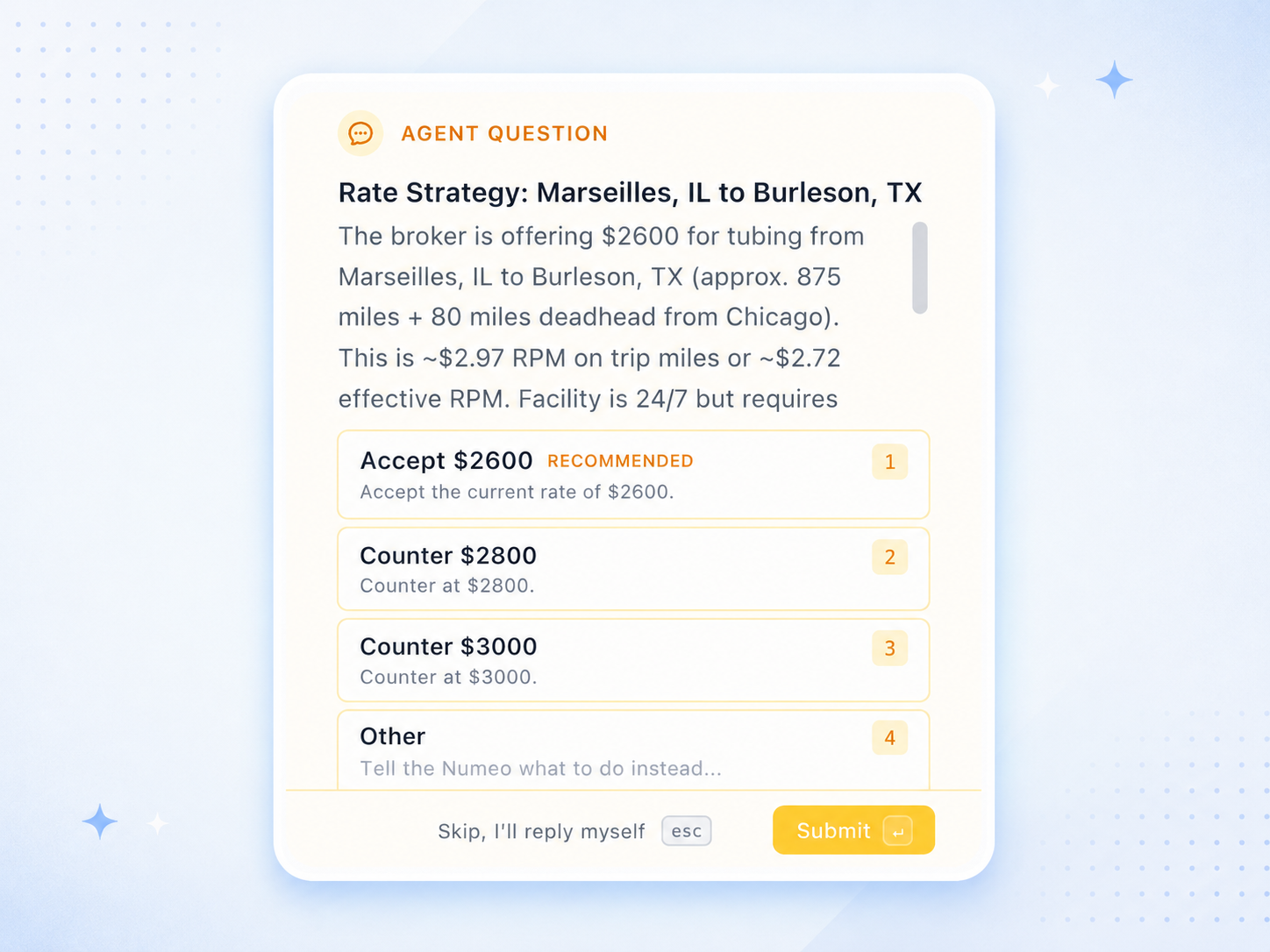
You also choose how much autonomy the agent has in the first place. In manual mode it mostly consolidates your boards. In supervised mode it suggests loads and can open broker contact, but waits for your approval on rate proposals and bookings. In autonomous mode it runs the search, ranking, outreach, and drafting inside your parameters and only escalates when judgment is required. You can switch modes whenever you want, which means you can adopt the automation gradually instead of betting the desk on it day one.
Market context, so you are not deciding blind
A broker offer means nothing without a benchmark. Is 2.40 a mile on this lane a gift or an insult? AI Hub answers that in the same view where you make the call. Alongside each offer it shows the historical rate for the lane and equipment, the current market average and trend, and where the broker's number lands against both.
That context is what turns an approval prompt into an informed decision instead of a gut call. You are not toggling back to a separate rate tool or pulling up last month's confirmations. The comparison is right next to the offer, so accepting, rejecting, or countering is grounded in what the lane has actually been paying.

Once you approve, AI Hub closes the loop with the broker, confirms the load details, and updates the status. The follow-up that used to mean another round of emails happens on its own, and the load moves to booked.
What is genuinely new here
Plenty of tools search load boards. Plenty of tools store your rate history. What AI Hub does that is different is run the whole loop, find to rank to draft to book, on one surface, with the dispatcher's rules as the filter and the dispatcher's approval as the gate.
The shift is about sequencing. In a manual workflow you do every step yourself, in order, and the time cost is the sum of all of them repeated across every truck. AI Hub lets you move earlier in the load lifecycle without watching every board and every inbox by hand. The software handles the parts that are repetitive and time-sensitive. You handle the parts that affect price, commitment, and strategy. That division is the point, and it is why the status layer and the approval prompts are not afterthoughts but the core of the design.
If you run a small fleet and you are the search, the math, and the negotiation all at once, this is built for exactly that desk. Start a 14-day free trial of AI Hub and let the agent take the repetition so you can keep the judgment.
Try Numeo
Ready to find better loads?
Numeo automates load search, rate negotiation, and broker emails — so you spend more time moving freight.
Explore Numeo
Related posts
Introducing Load Hub: One Search for Every Board
Load Hub searches 15+ load boards and broker portals from one place, ranks results for your truck, and pushes alerts the second freight matches.
May 21, 2026 · 7 min read
ProductLoad Radar: Load Hub Alerts When Freight Posts
Load Radar is the Load Hub feature that watches your lanes across connected boards and alerts you the second a matching load posts.
May 21, 2026 · 7 min read
GuidesIs AI Dispatch Worth It for Small Carriers?
A straight answer for carriers with 1 to 10 trucks: when AI dispatch actually earns its keep, and when you are better off skipping it.
Mar 24, 2026 · 7 min read